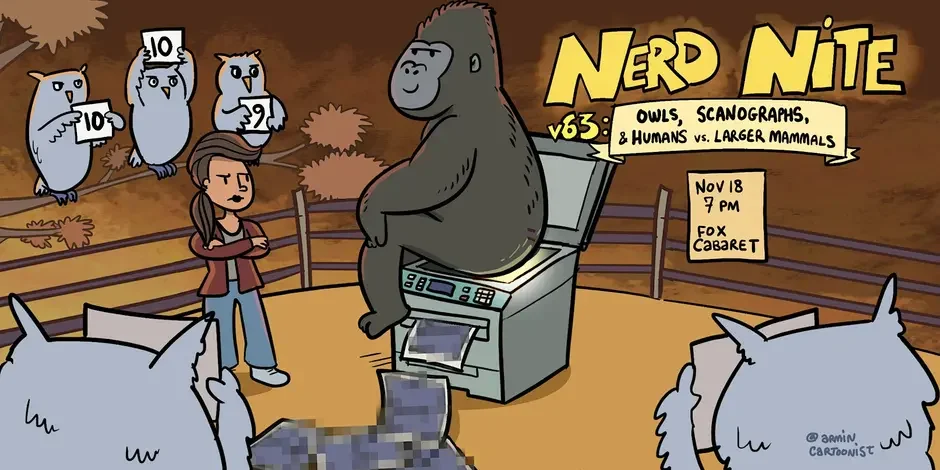
Nerd Nite is back with Nerd Nite v63: Owls, Scanographs, and Humans vs. Larger Mammals!
Doors: 6:45pm
Tickets: see below
19+/General Admission
Nerdy Science Lecture series continues!
What do silent night hunters, art made on a flatbed scanner, and our long, messy rivalry with the big beasts have in common?
We find out together, drink in hand, at the Fox Cabaret, our nerd herd den.
This is the second and final night of our Fall series, so it’s your last chance to nerd out with us before the year wraps. Don’t miss it!
As always, proceeds from this event go to a good cause. This month we’re sponsoring the Student Presentation Award at Cascadia 2027, a local conference on occupational, environmental, and population health. The award recognizes students who combine scientific curiosity with great communication, which is pretty much the Nerd Nite spirit in award form.
The Elusive Forest Ping-Pong Ball - Megan Buers
Description: How do you study something small, nocturnal, nearly impossible to see and, above all, very sneaky? Until recently, studying Western Screech-Owls mostly meant night surveys, hoping one moved into a nest box, or getting lucky and spotting one roosting during the day. New technology is changing that. With tiny tracking devices and “robot ears,” which are acoustic recorders that listen through the night, we’re finally learning what these stealthy little Strigiformes get up to after dark.
Bio: Megan Buers has spent the past decade working with owls across Canada, mostly Western Screech-Owls. She did her MSc on the interior subspecies and is now doing a PhD on their coastal cousins, which are proving even trickier. After two years of fieldwork in some of the more remote corners of Vancouver Island, she’s here to share the wins and losses of studying such sneaky birds. She loves wildlife photography of all kinds and is an avid iNaturalist user (you can find her photos on Instagram at @bigbirdmegan). She has a deep love of non-fiction and is currently reading The Lord of the Rings.I can certainly cut this down if it's too long, just let me know if it doesn't fit your length requirements. Let me know if you need any photos or anything. Just to confirm, I have 12 minutes to talk, is that correct? Looking forward to it!
Scanography - Alex Waterhouse-Hayward
Description: I am 84 and i walk well and have a sense of purpose because of the almost forgotten existence of the 20th century technology that is the good Epson scanner. I scan the negatives (35mm & 120) and Ektachromes plus I use my scanner as a tabletop camera. In Vancouver we have the fab The Lab that processes my film and Ektachrome plus Beau Photo has a huge fridge with film you may have never heard of. If anything my presentation will show how wonderful it is to combine the technology of the 20th century with that of the 21st.
Bio: I was born in Buenos Aires on August 31, 1942. My birth was recorded by a photographer with a burst of a magnesium flash. I knew then I would become a photographer. I bought my first camera in Austin, Texas in 1959. With my Canadian wife and 2 daughters we moved to Vancouver from Mexico City in 1975. Until magazines disappeared and journalism died I was a magazine photographer here. I now write a blog (7050 of them) scan my plants and negatives, shoot film & digital and live alone with a female cat in Kitsilano. I miss my wife (52 years married) who died 6 years ago.
No Room to Roam: How Animals Navigate a Human-Dominated World - Kaitlyn Gaynor
Abstract: Human activities shape the lives of wild animals in ways that are often invisible to us. Around the world, animals are changing where they go, what they eat, and what they do in response to people. In this talk, wildlife ecologist Kaitlyn Gaynor will share stories from research across the globe, from lions in Mozambique, tigers in Nepal, and bears in California (oh my!). Drawing on studies of animal movement and human-wildlife interactions, she'll explore how animals navigate novel risks and benefits associated with life alongside people. By understanding how wildlife responds to our presence, we can better design conservation strategies that support multispecies coexistence on an increasingly crowded planet.
Bio: Kaitlyn Gaynor is an Assistant Professor of Zoology and Botany at the University of British Columbia. Her entry point into science was a fascination with animal behaviour, and her interests have since evolved to include the cascading consequences of disturbance for ecological communities, and the social dimensions of human-wildlife coexistence. Her current research program is grounded in a fundamental interest in behavioural and community ecology, with an increasingly applied and interdisciplinary focus, and collaboration is her favorite aspect of research. Outside of science, she nerds out about cooking vegetables, having too many bicycles, and exploring new cities.
